

Master the Scrum
Principles that drive
results
Six foundational principles sit at the heart of Scrum — shaping how teams plan, work together, prioritize, and deliver. They keep you adaptive, transparent, and consistently focused on what matters.

Scrum principles are the essential guidelines that underpin the entire framework. They help teams make sound decisions, respond to change with confidence, work collaboratively, and produce meaningful outcomes — all within a structured yet flexible approach.
The six principles of Scrum
Each principle addresses a distinct aspect of how Scrum teams operate — and together they form an interconnected way of working that fosters learning, accountability, and consistent delivery.
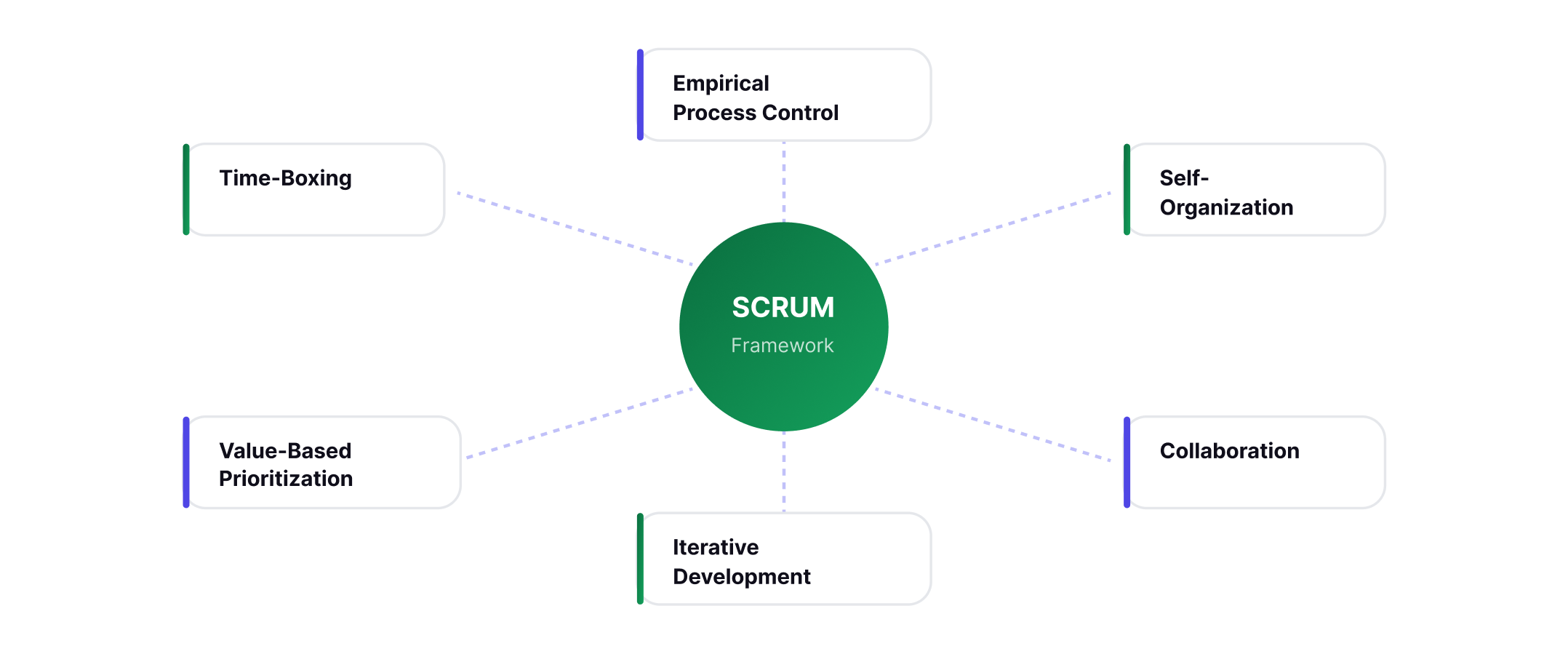
All six Scrum principles are mutually reinforcing — each one strengthens the others as part of a unified system.
Empirical Process Control
Scrum is grounded in observation, continuous learning, and timely adjustment — not in the assumption that everything can be predicted from the start.

Empirical Process Control is one of Scrum's most fundamental ideas. It acknowledges that most projects involve uncertainty, shifting requirements, and evolving stakeholder needs. In these conditions, detailed upfront planning alone is insufficient — teams must learn from real work as it unfolds.
This principle rests on three connected pillars: transparency, inspection, and adaptation. Transparency ensures that the state of work is visible to everyone involved. Inspection allows teams and stakeholders to review what's been accomplished at regular intervals. Adaptation makes it possible to adjust priorities, plans, or direction when the evidence calls for it.
What it emphasizes
- Work should be visible and easy to understand
- Progress should be reviewed at consistent intervals
- Teams should adapt based on what they observe
Why it matters
- Lowers the risk of persisting on the wrong course
- Accelerates learning in complex environments
- Enables evidence-based decision making
In practice: Sprint Reviews and Retrospectives are direct expressions of empirical thinking. Teams examine outcomes, collect feedback, and refine their approach before the next cycle begins.
Self-Organization
Scrum teams are empowered to structure their own work, take full ownership, and determine the best path to achieving agreed outcomes.

Self-Organization means the team doesn't rely on external direction for every decision. Members work together to determine how to approach their work, allocate responsibilities, and resolve problems as they surface.
This principle is grounded in the belief that people perform better when they have genuine ownership over their work. It also aligns with servant leadership — where leaders focus on enabling the team rather than controlling every aspect of how work gets done.
What it encourages
- Collective ownership of goals and outcomes
- Stronger motivation and genuine team commitment
- Faster, more autonomous decision making
Why it matters
- Drives accountability within the team itself
- Opens space for creative problem solving
- Strengthens trust and overall collaboration
In practice: In Sprint Planning, the team determines how much work it can realistically take on and how it will be carried out — rather than receiving a predetermined plan from above.
Collaboration
Scrum relies on people working closely together, sharing information openly, and staying aligned on goals, progress, and key decisions.

Collaboration in Scrum goes well beyond simply communicating. It requires people to work toward a shared purpose, contribute meaningfully to collective outcomes, and remain conscious of how their work connects with what others are doing.
SCRUMstudy frames collaboration through three core dimensions: awareness, articulation, and appropriation. Teams need visibility into each other's work, the ability to divide and integrate tasks effectively, and the flexibility to adapt tools and approaches to suit their actual working context.
Key dimensions
- Visibility into what teammates are working on
- Effective coordination of shared responsibilities
- Flexibility to adapt tools and methods as needed
Benefits
- Strengthens alignment across roles and stakeholders
- Cuts down on miscommunication and rework
- Elevates the quality of team problem solving
In practice: Daily Scrums promote ongoing coordination by keeping team members informed of progress, impediments, and what needs attention next.
Value-Based Prioritization
Scrum directs teams to tackle the highest-value work first, ensuring meaningful outcomes are delivered early and consistently.

Value-Based Prioritization ensures teams are not just keeping busy — they are focusing their energy on what genuinely matters. Rather than treating all requirements as equally important, Scrum organizes work according to business impact and customer value.
SCRUMstudy identifies three key considerations when sequencing work: value, risk or uncertainty, and dependencies. Weighing these factors helps teams order their backlog in a way that balances impact, complexity, and real-world constraints.
What guides prioritization
- Business or customer value
- Risk and uncertainty
- Dependencies between items
Why it matters
- Drives early delivery of high-impact outcomes
- Maximizes return on time and effort
- Keeps the backlog aligned with actual priorities
In practice: The Product Owner sequences the Product Backlog so the team consistently works on what delivers the greatest value — not just what comes next in a list.
Time-Boxing
Scrum applies fixed time limits to sharpen focus, improve predictability, and keep work progressing at a sustainable pace.

Time-Boxing means every activity runs within a defined maximum duration. Rather than allowing work or meetings to expand without limit, Scrum sets firm boundaries around key events — including Sprints, Daily Scrums, Sprint Planning, Sprint Review, and Sprint Retrospective.
This principle strengthens discipline and sharper decision-making. It pushes teams to concentrate on what's most important, eliminate unnecessary delays, and establish a reliable cadence that stakeholders can count on.
What it supports
- Focused discussions and sharper execution
- A consistent planning rhythm and team cadence
- Fewer delays and less scope drift
Why it matters
- Sets clear expectations for all involved
- Improves scheduling reliability and forecasting
- Keeps teams consistently moving toward delivery
In practice: A Sprint typically runs for one to six weeks, and the Daily Scrum is deliberately brief so that team coordination happens efficiently without eating into productive time.
Iterative Development
Scrum builds and refines the product through repeated cycles, drawing lessons from each increment to improve what comes next.

Iterative Development treats the product not as a single large delivery, but as something that takes shape through a series of smaller, focused increments. Each cycle creates a natural checkpoint — an opportunity to review what was delivered, gather real feedback, and sharpen the direction ahead.
This principle significantly reduces risk because teams don't wait until the end to validate their assumptions. It also supports ongoing learning, which is especially valuable when requirements shift or clarity develops progressively over time.
What it encourages
- Regular delivery of usable, working progress
- Ongoing feedback loops and continuous improvement
- Refinement grounded in real-world experience
Why it matters
- Eliminates costly late-stage surprises
- Keeps teams responsive as needs change
- Builds momentum through consistent, measurable progress
In practice: Each Sprint concludes with a reviewable increment — something tangible that can be validated and used to inform future backlog decisions.
How these principles support Scrum delivery
Taken together, these principles define how effective Scrum teams operate — each one reinforcing the others within a unified, connected system.

Learn from Reality
Empirical thinking grounds teams in what's actually happening — not assumptions — so every decision is backed by evidence gathered through real work.

Strengthen Execution
Self-organization and collaboration produce teams that take genuine ownership, tackle challenges directly, and stay aligned around shared goals.

Stay Focused on Value
Value-based prioritization ensures every Sprint is spent on what matters most — so the team delivers real impact, not just activity.

Maintain Rhythm
Time-boxing instills the structure and discipline that keeps teams on track and progressing — without unnecessary pauses or drift.

Continuously Improve
Iterative development keeps teams learning and delivering in steady increments — lowering risk while building consistent forward momentum.

Build the Foundation
A solid command of these six principles gives practitioners the grounding they need to apply Scrum with both confidence and consistency.
Strengthen your Scrum foundation with GetCertNow
A clear grasp of Scrum principles is the foundation for applying the framework with real confidence. Explore GetCertNow's Scrum learning options to deepen your understanding and connect these principles directly to how projects get delivered.
